Build relationships
that compound.
See the relationship. Score it. Strengthen it.
The leading indicator beneath your CAC
Most brands measure customer acquisition. Few measure the thing that determines what acquisition costs them: the structural quality of the relationships they're building. The Four Pillars of Customer Acquisition™ is a diagnostic that scores that structure, so you can see where the relationship weakens before it shows up in the financials.
The structural quality of your customer relationships is the variable most brands never measure, and the one that determines your cost of acquisition. Weak architecture shows up as rising CAC and softening retention before the financials confirm it. Strong architecture compounds into growth you don't have to keep paying for.
When relationships are structurally strong, customers stay, refer, and return, and acquisition gets cheaper because your existing base does the work. When relationships are structurally weak, you replace churned customers with paid ones, and CAC climbs to cover the leak. The financials register this late. The relationship architecture registers it early.
That is what the Four Pillars diagnostic measures. Not sentiment, not reputation, not a satisfaction score, but the structural conditions that determine whether your acquisition compounds or erodes.
We show you exactly where your relationship architecture is strong or weak, and what that means for the numbers you already track, CAC and retention included, so you can act on the cause instead of the symptom.
Your current metrics tell you what already happened to the relationship. The Four Pillars tells you what is about to.
Four dimensions. One reinforcing system.
The Four Pillars are not independent variables. Each one depends on and amplifies the others. A brand that builds all four creates a customer relationship that becomes more valuable over time — independent of how much the customer has spent.
How deeply does your brand embed itself in the lives and communities of your customers?
Does your brand make its customers genuinely smarter and more capable over time?
Does your brand make customers more capable, more confident, and more themselves?
Does the brand relationship become more valuable over time — independent of spend?
The Four Pillars of Customer Acquisition™ is grounded in established academic theory — social capital research, self-determination theory, self-efficacy theory, and relationship marketing — and operationalized as a 16-subcategory diagnostic instrument scored out of 100.
Score your brand’s relationship architecture.
Most brands don’t know their score. Now you can.
Eight minutes. Sixteen questions. A scored profile across all four pillars — with a band classification that tells you where your brand’s relationship architecture is strong and where it is leaving compounding returns on the table.
Answer based on your brand’s actual practice — not its aspiration. The diagnostic value comes from honest self-reporting. Score for the current state of your brand, not where you plan to be.
See what your relationship architecture is doing to the numbers you already track.
One last step.
Enter your first name and email to unlock your full score breakdown across all four pillars — with a Growth Index classification, pillar-by-pillar CAC implications, and a prioritized interpretation of where your brand’s relationship architecture is strongest and most fragile.
Your first name and email only. You’ll receive your results and the occasional piece of content worth reading.
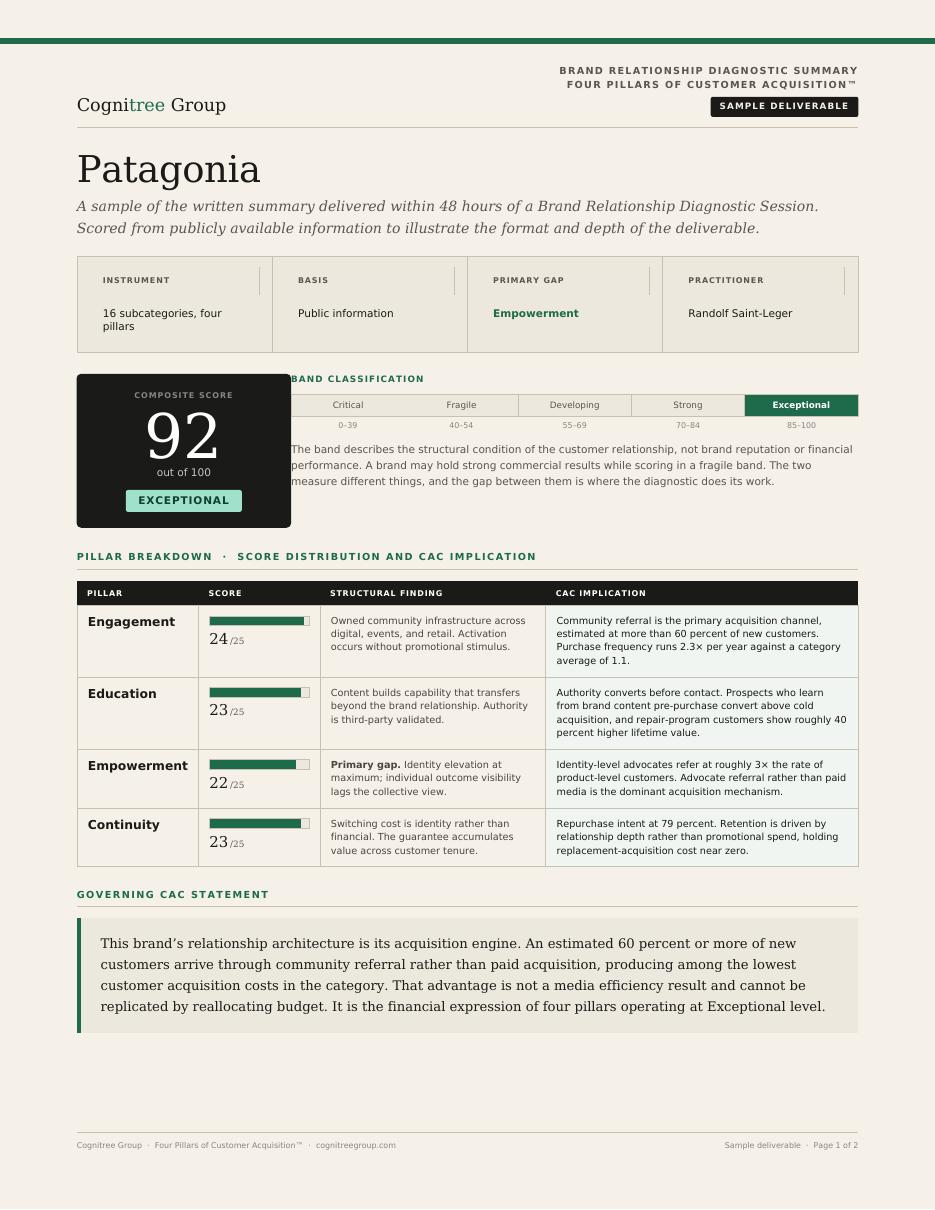
What a diagnostic produces.
A self-assessment gives you a score. An administered diagnostic gives you the architecture underneath it. This two-page sample — scored on Patagonia using publicly available information — shows the composite and band, the pillar breakdown with CAC implication, the governing finding, and a fully written observation with its recommendation.
View the sample summary (PDF) → How a diagnostic session works →
What the framework reveals.
The Four Pillars diagnostic has been applied retrospectively across 20+ brands. A selection of scores from the case library — each one a precise structural finding, not a reputation assessment.
The body of work.
Every article, case study, and newsletter issue published under the Four Pillars of Customer Acquisition™ framework — from the original 2019 provenance pieces through the current practice.
Home Depot's relationship score barely moved, 65 to 63, which reads as a brand holding steady. Underneath, the DIY customer it was built to teach is thinning while a roughly 24 billion dollar Pro business compounds. A single blended score cannot hold two diverging customers at once.
Regulators, customers, and competitors are all pulling away the friction that held subscription retention in place. A strong retention number can hide a weak relationship, and the difference shows the moment leaving becomes easy.
Sony PlayStation is the only brand in the library to improve across every period, which is what makes the decision to end physical discs a test rather than a verdict. When a brand removes what its most loyal customers thought they owned, the relationship it converts from ownership into access is the one the diagnostic measures.
Netflix has never left the Developing band across 27 years of operation. Not because the content failed. Because the identity belongs to the show, the character, the story. The password sharing restriction revealed that subscriber satisfaction was content-dependent rather than relationship-deep.
Nine individually sound decisions compounded into a 39-point diagnostic collapse. The Starbucks case is the clearest illustration of what happens when a brand confuses a coupon book with a loyalty program. Strong band to Critical band.
Bud Light held the number one US beer position for twenty-one consecutive years while scoring 44 out of 100 on the Four Pillars diagnostic. Fragile band. The diagnostic recorded the structural condition before the April 2023 campaign confirmed it publicly.
Nike scored 83 out of 100 at peak. Strong band. The Consumer Direct Acceleration strategy cut the wholesale community that anchored brand advocacy and produced 18 months of diagnostic warning before the stock confirmed the structural consequence.
Rising customer acquisition cost is not a media efficiency problem. It is a relationship architecture problem. The first issue of Relationships That Compound makes the structural argument.
Glossier built one of the most instructive Education-first brand architectures of its generation — then eliminated it in a single cost-reduction decision. A Four Pillars case study.
Patagonia's revenue quadrupled in a decade. Peloton lost 95% of its market value. The Four Pillars of Customer Acquisition™ framework explains the structural difference — and why it matters for every brand building customer relationships today.
The second provenance article. Applied the Three Pillars framework to the ridesharing market — a brand that competed on price alone versus one that built a genuine relationship architecture. Published five years before the framework was formalized as a diagnostic instrument.
The founding article. Introduced the framework's original thesis using TiVo and Netflix as the central case study — a product with superior technology and no relationship architecture versus one that compounded its customer relationships over time. First published February 3, 2019.
Consulting built on a diagnostic, not an opinion.
Cognitree Group is a consulting practice founded by Randolf Saint-Leger. Its work is organized around a single conviction: that the structural quality of a brand's customer relationships is measurable, and that measurement is the precondition for meaningful improvement.
The Four Pillars brand relationship diagnostic produces a scored profile across four dimensions and 16 subcategories — a map of where a brand's relationship architecture is strong, where it is fragile, and where compounding returns are being left on the table.
What's being published.
Weekly diagnostic observations on brand relationship architecture. One substantial post per week. One newsletter issue per month. All grounded in the Four Pillars case library.